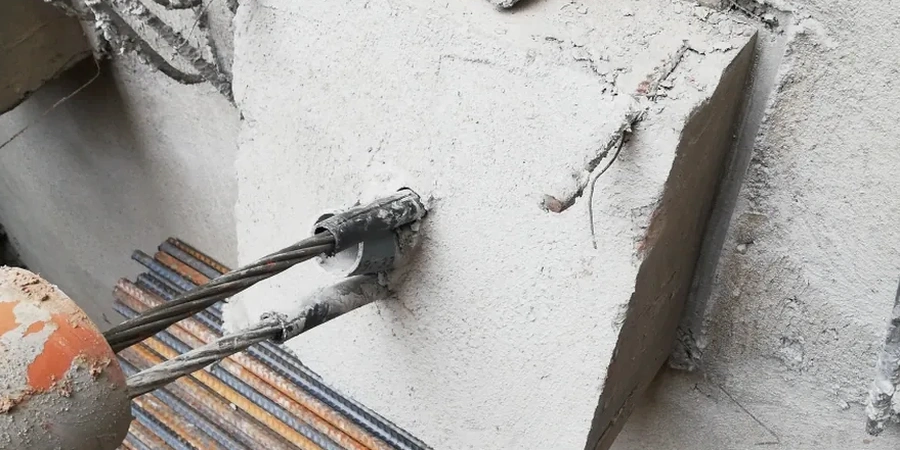
A common mistake we see in Toowoomba is treating a grouted ground anchor as a simple steel tendon with no consideration for the bond zone geology. When a contractor installs anchors into the region's deeply weathered basalts or the expansive black soil plains without verifying the grout-soil interface, the consequences show up fast: excessive creep under lock-off load, or worse, a retaining wall that starts to tilt during the wet season. Our laboratory team approaches anchor design by first characterizing the in-situ stratigraphy at the borehole scale, then calculating the ultimate bond stress based on actual friction angles and undrained shear strengths—not generic textbook values. For excavations near the Toowoomba Range escarpment, where colluvial deposits mask the contact between residual basalt and the underlying Walloon Coal Measures, we often recommend coupling the anchor investigation with a CPT test to capture continuous tip resistance profiles that a standard SPT might miss in interbedded claystone layers. This data feeds directly into the load-transfer model so the anchor free-length and bond-length are sized for the specific conditions at your site, not a conservative assumption that wastes steel and drilling time.
An anchor's capacity is not a property of the steel tendon—it is a property of the grout-soil interface, and that interface behaves differently in Toowoomba's weathered basalt than it does in Brisbane clay.
FAQ
What is the difference between an active and a passive anchor, and when do I need each in Toowoomba?
An active anchor is pre-tensioned during installation to apply a known force to the structure from day one, which is essential for retaining walls where you need to control immediate lateral deflection. A passive anchor is not tensioned; it only develops resistance when the structure moves enough to mobilize the bond strength, so it is used in rock bolts or soil nails where some deformation is acceptable. In Toowoomba, we typically specify active anchors for permanent tied-back walls supporting public roads, and passive anchors for temporary excavation support or rock slope stabilization on the Range escarpment.
How much does an anchor design and testing package cost for a Toowoomba project?
For a complete anchor investigation and testing programme in Toowoomba—including one geotechnical borehole, laboratory strength testing of bond zone soils, design calculations for up to three anchor types, and on-site proof testing of two anchors—budget between AU$1,400 and AU$5,440 depending on access conditions, drilling depth, and whether the anchors are temporary or permanent with double corrosion protection.
Why does AS 4678 require creep testing for anchors in clay soils?
Creep testing under sustained load is required because fine-grained soils, particularly the reactive clays common in Toowoomba's western suburbs, exhibit time-dependent deformation at the grout-soil interface. If an anchor is locked off and the bond zone creeps, the load transfers to the structure as additional deformation. The standard's acceptance criterion—typically less than 2 mm of movement per log cycle of time during a 60-minute hold—ensures the anchor will not lose pre-stress gradually over the design life of the structure.
How do you determine the correct bond length for an anchor in weathered basalt?
We determine bond length by first logging the rock mass weathering grade (AS 1726 classification from fresh to completely weathered) along the anchor alignment, then assigning a conservative ultimate bond stress for each zone based on unconfined compressive strength tests of the intact rock and the rock mass rating. In Toowoomba's weathered basalts, where the transition from extremely weathered to moderately weathered can occur over less than 2 metres vertically, we typically extend the bond zone at least 1 metre into the moderately weathered horizon and verify capacity with a sacrificial test anchor loaded to 1.5 times the design ultimate load.