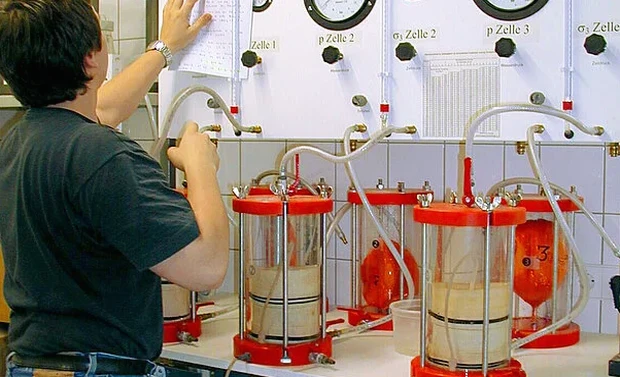
In Toowoomba, the difference between a pavement that lasts and one that fails in three seasons comes down to the subgrade. We see it often on the eastern escarpment, where basalt-derived clays dominate. The material looks firm when dry but loses strength fast with moisture. A laboratory CBR test removes that guesswork. It measures the bearing capacity of the compacted soil under controlled conditions, simulating years of traffic loading. For projects along the Warrego Highway corridor or in new subdivisions near Highfields, this data shapes the pavement thickness, the stabilisation strategy, and the final construction budget. We complement the test with grain size analysis when fines content needs verification, and with Atterberg limits to confirm plasticity behaviour of the local dark cracking clays.
A soaked CBR value on black earth in Toowoomba can be one-third of the unsoaked figure. Designs based on dry-season data alone carry a hidden risk.
FAQ
How much does a laboratory CBR test cost in Toowoomba?
A standard CBR test on a single remoulded specimen ranges from AU$210 to AU$350, depending on whether soaked or unsoaked conditions are required and the number of compaction points. A package with three specimens at three moisture contents, plus Atterberg limits and particle size distribution, typically falls between $600 and $950. We provide a firm quote after reviewing the project scope and number of samples.
How many CBR specimens do I need for a residential subdivision in Toowoomba?
For a subdivision with uniform geology, we recommend one CBR test per major soil type encountered, with a minimum of three specimens per soil type compacted at different moisture contents. For a typical 20-lot development on the Toowoomba plateau, this usually translates to 6 to 9 CBR specimens across the site.
Do you test in-situ CBR as well or just laboratory?
Our primary service is the laboratory CBR test on remoulded specimens, which gives the design CBR at specified compaction and moisture conditions. For field CBR on natural ground, we can arrange it through our mobile testing partners. We recommend laboratory CBR for pavement design because it provides the soaked value that governs long-term performance.
What CBR value does TMR require for a residential street?
The Queensland Department of Transport and Main Roads (TMR) typically specifies a minimum soaked CBR of 5% for the subgrade under a residential access street. If the natural material falls below this, the design must include a capping layer, stabilisation, or a thicker pavement structure. Our reports present the CBR value and the compaction curve so the design engineer can check compliance directly.