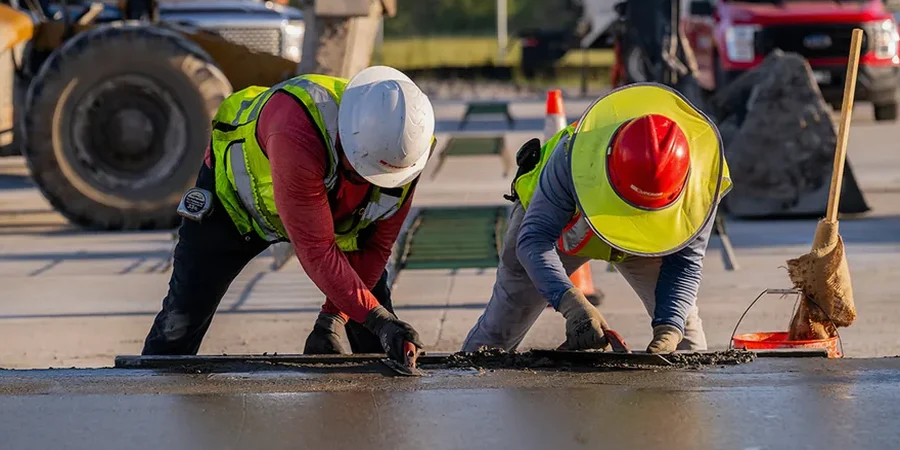
Austroads AGPT02-24 and AS 3727 establish the structural framework for concrete pavements in Australia, yet their application in Toowoomba demands a focused understanding of local geology. The city sits atop the Great Dividing Range at approximately 700 metres elevation, an environment where basalt-derived vertosols dominate the landscape. These highly reactive clay soils undergo pronounced shrink-swell cycles that directly influence rigid pavement design, making a generic approach unsuitable. A rigid pavement must distribute traffic loads across these expansive subgrades without allowing differential movement to compromise joint integrity. The design process involves matching slab thickness, reinforcement, and joint spacing to the specific CBR values obtained from grain-size and Atterberg limits tests conducted on site. Toowoomba's industrial areas, including the Wilsontown precinct and the Charlton logistics hub, host continuous heavy vehicle traffic that demands rigorous structural analysis. Our team integrates laboratory data with climatic modelling to deliver rigid pavement designs that resist curling stress, base erosion, and the fatigue cracking common in the region's freeze-rare but thermally active environment.
A rigid pavement on reactive Toowoomba clay without a stabilised subbase is not a road—it is a future liability with a programmed crack pattern.
Scope of work
Toowoomba's urban expansion over the last two decades has transformed its geotechnical landscape. Agricultural land once used for cropping has been converted into subdivisions and warehouses, compacting the upper soil profile in ways that engineers must now address. Rigid pavement design in these areas must consider the pre-consolidation history of the subgrade and the potential for residual settlement beneath heavily loaded slabs. Key characteristics of our approach include evaluating the coefficient of subgrade reaction (k-value) through plate load testing, determining the modulus of rupture required for the concrete mix, and analysing the fatigue life of the pavement under projected axle repetitions. We model temperature differentials that can exceed 25 degrees Celsius between the top and bottom of a slab during Toowoomba's clear summer days, a factor that introduces significant warping stresses. The design also accounts for tied concrete shoulders, dowelled contraction joints, and the use of lean-mix concrete subbases to prevent pumping at joints—a condition aggravated by the fine-grained vertosol subgrades that lose strength when saturated after the region’s intense summer storms.
Area-specific notes
Toowoomba's position on the crest of the Great Dividing Range exposes rigid pavements to a unique contrast: hot, dry westerly winds in summer and penetrating winter frosts that can reach the surface of the concrete. This thermal regime creates a fatigue environment where daily temperature swings cycle the slab through expansion and contraction, testing every joint and reinforcement detail. The vertosol subgrades amplify the risk: during late winter and early spring, the soil profile can remain near saturation for weeks, reducing bearing capacity to its lowest point precisely when slab curling concentrates wheel loads at the pavement edges. Poorly designed rigid pavements in these conditions develop corner breaks, transverse cracking, and joint faulting within the first five years of service. The regional freight routes feeding the Toowoomba Bypass and the Wellcamp Airport precinct carry loaded B-doubles that impose extreme edge stresses, making subbase drainage and longitudinal joint design critical. A comprehensive rigid pavement design must integrate a subsurface drainage plan, a geotextile separation layer over the subgrade, and a non-erodible granular subbase to mitigate the risk of fines migration and loss of support.
FAQ
What is the typical design life of a rigid pavement in Toowoomba's soil conditions?
Industrial rigid pavements are typically designed for a structural life of 30 to 40 years when the subgrade is properly stabilised. For residential concrete pavements designed to AS 3727, a design life of 25 years is standard, provided the vertosol subgrade is treated with lime or cement stabilisation to control shrink-swell movement.
How do Toowoomba's reactive clays affect concrete pavement performance?
The basalt-derived vertosols can exert swell pressures exceeding 150 kPa when moisture increases beneath a covered slab. This causes differential heave that leads to joint stepping and slab cracking. Our designs mitigate this by specifying a minimum 150 mm stabilised subbase layer and ensuring positive drainage away from the pavement edges to maintain a consistent moisture regime.
What is the cost range for rigid pavement design services for a typical industrial lot in Toowoomba?
Rigid pavement design for a standard industrial development in Toowoomba ranges from AU$2,970 to AU$10,340, depending on the site area, required geotechnical investigation depth, and traffic loading complexity. This covers the structural analysis, jointing plan, and specifications for the subbase and concrete mix.
Do you consider the Toowoomba Bypass traffic loading in your designs for nearby developments?
Yes, any rigid pavement design near the Toowoomba Bypass corridor or the Charlton logistics precinct must account for diverted heavy vehicle traffic. We use traffic count projections from the Department of Transport and Main Roads, converting them into ESAL repetitions to ensure the pavement can handle the concentrated freight movements without premature fatigue failure.