← Home · In-Situ

Field Permeability Testing (Lefranc & Lugeon) in Toowoomba’s Basaltic Terrain

Together, we solve the challenges of tomorrow.

DISCOVER →

Toowoomba’s expansion along the eastern escarpment of the Great Dividing Range pushes new infrastructure onto weathered basalts and reactive clays where drainage behavior controls long-term stability. At our laboratory, the field permeability test remains the definitive method for quantifying hydraulic conductivity in these complex residual profiles. Unlike desktop estimates that ignore secondary porosity in vesicular basalt, a properly executed Lefranc or Lugeon test captures the actual water take in discrete intervals. For dam spillways near Cooby Creek or deep stormwater sumps in the Toowoomba CBD, these measurements feed directly into seepage analyses and dewatering design. When a slope stability assessment relies on pore pressure assumptions, in-situ permeability data replaces guesswork with site-specific values that reflect the true fracture network within the Toowoomba basalt sequence.

A single Lugeon test in fractured Toowoomba basalt can reveal a tenfold variation in hydraulic conductivity across a two-metre test interval.

Scope of work

AS 1726 sets the framework for geotechnical site investigations in Australia, and Appendix E outlines the procedures for variable-head and constant-head tests that underpin our Lefranc methodology in Toowoomba. When bedrock permeability governs the design, the Lugeon test follows the Houlsby interpretation, where five pressure stages define the flow regime: laminar, turbulent, dilation, washing-out, or fracture filling. This level of detail matters in Toowoomba because the Tertiary basalts display a characteristic vesicular texture that produces Lugeon values ranging from 1 to over 50 Lu within a single borehole, depending on whether the test zone intersects a vesicular layer or a massive, unfractured flow unit. Our technicians log the pressure-flow curve in real time and flag any non-linear behaviour immediately. For earthworks over colluvium, we often pair permeability testing with a proctor test to ensure that compacted clay liners achieve the specified hydraulic barrier performance, particularly for landfill cells and tailings storage facilities around the Darling Downs region.
Field Permeability Testing (Lefranc & Lugeon) in Toowoomba’s Basaltic Terrain
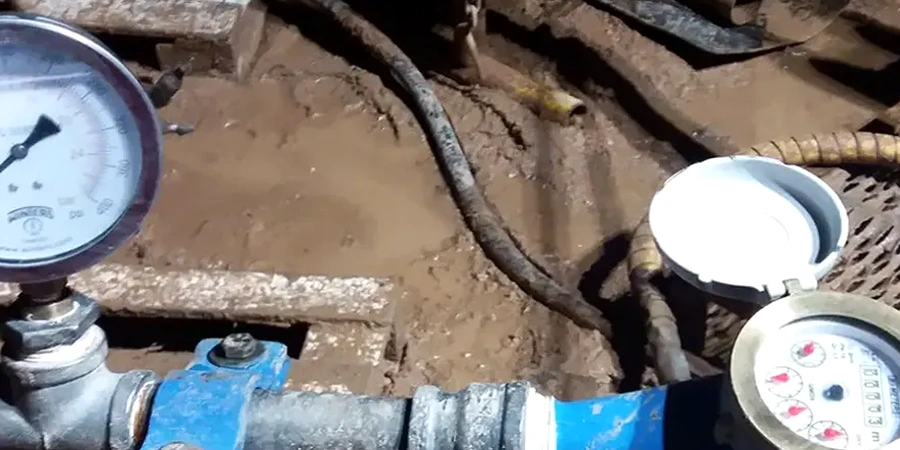
Technical reference image — Toowoomba

Area-specific notes

The sharp rainfall gradient across the Toowoomba Range, where annual totals swing from 700 mm on the western downs to over 1000 mm near the escarpment crest, creates a groundwater regime that surprises even experienced geotechnical engineers. Perched water tables within the deeply weathered basalt can develop rapidly after sustained rain, generating pore pressures that conventional drainage models fail to predict. A Lefranc test in a borehole within the clay-rich colluvium often reveals permeability two orders of magnitude lower than the open-jointed basalt just metres below. We have seen excavations near the Toowoomba Bypass where untreated groundwater inflow turned cut faces to slurry within hours because the design assumed homogeneous conditions. In these situations, the Lugeon test quantifies fracture flow under pressure, allowing grouting or grouting programs to be sized accurately before the excavation phase begins. The cost of skipping this step in Toowoomba’s layered basaltic terrain almost always materialises as construction delays and emergency dewatering.

Need a geotechnical assessment?

Reply within 24h.

Email: contact@geotechnicalengineering1.xyz

Technical parameters


ParameterTypical value
Test methodConstant head / Falling head (Lefranc); 5-stage pressure (Lugeon)
StandardAS 1726 (Geotechnical site investigations); Houlsby method for Lugeon interpretation
Borehole diameterNQ (75 mm) to PQ (122 mm), depending on packer size
Test interval length0.5 m to 5 m (Lefranc); typically 3 m to 6 m (Lugeon)
Pressure stages (Lugeon)5 steps: P_low, P_med, P_max, P_med, P_low
Measurement parameterk (m/s) for Lefranc; Lugeon unit (Lu) for rock mass permeability
Typical k range in Toowoomba basalt10⁻⁷ m/s (clay-filled joints) to 10⁻⁴ m/s (open vesicular zones)
ReportingPressure-flow plots, Lugeon pattern classification, transmissivity estimate

Linked services

01

Lefranc Test in Overburden

Variable-head and constant-head permeability measurements in soil and highly weathered rock, executed inside boreholes or CPT soundings. We use a 50 mm diameter slotted PVC screen with clean gravel pack, isolating test intervals from 0.5 to 5 metres. Each test runs until steady-state flow is confirmed, with temperature correction applied. Results are reported as hydraulic conductivity (k) in m/s, suitable for dewatering design, seepage modelling, and landfill liner verification.

02

Lugeon Test in Fractured Basalt

Pressurised water testing in bedrock using single or double packer assemblies, following the five-stage Houlsby cycle. We record flow rate at each pressure increment and classify the resulting curve as laminar, turbulent, dilation, wash-out, or fracture filling. This classification directly informs grouting take estimates and dam foundation acceptance criteria. Tests are performed in HQ or NQ boreholes at Toowoomba sites where abutment cutoff design depends on reliable rock mass permeability values.

Standards used

AS 1726, AS 4678, Houlsby (1976) – Lugeon test interpretation

FAQ

What is the cost of a Lefranc or Lugeon permeability test in Toowoomba?

In-situ permeability testing in the Toowoomba region typically ranges from AU$1090 to AU$1600 per test interval, depending on access conditions, test depth, and whether a Lefranc (soil) or Lugeon (rock) setup is required. The price includes packer installation, flow measurement instrumentation, data logging, and a signed report with pressure-flow plots.

When is a Lugeon test necessary rather than a simple Lefranc test?

A Lugeon test becomes necessary when the investigation encounters bedrock, particularly the fractured Tertiary basalt common beneath Toowoomba. The Lefranc method works well in soil and completely weathered material where the borehole wall can support an open test section. In competent, jointed rock, the Lugeon test applies pressure up to 1 MPa to force water into tight fractures, revealing flow regimes that a gravity-fed Lefranc test cannot detect. The Houlsby five-stage pressure cycle also distinguishes between laminar fracture flow and hydraulic jacking, which is critical for dam grouting design.

How many test intervals do you recommend for a typical dam site investigation near Toowoomba?

For a dam foundation on Toowoomba basalt, we recommend testing every 3 to 5 metres of core run within the proposed cutoff zone, with at least three test intervals per borehole to capture the vertical variability. The vesicular nature of the local basalt means permeability can change abruptly at flow-unit boundaries. A minimum of five pressure stages per interval allows us to classify the flow regime and estimate the grout take before the grouting contractor mobilises. The investigation should also include at least one test in the abutment colluvium to assess the need for a clay blanket or cutoff extension.
Location and service area

We serve projects across Toowoomba and surrounding areas.

View larger map